
AI Review Summaries
Helping businesses turn large volumes of customer reviews into clear, actionable weekly insights.
Context
Trustpilot’s B2B app helps businesses understand their TrustScore, manage reviews and identify opportunities for improvement.
However, finding meaningful patterns across large volumes of review content was still a manual, time-consuming process.
We set out to use AI to turn reviews into clear, weekly, actionable themes, helping businesses understand what to improve and what to promote.
Constraints & limitations
Five-week delivery window
Limited team resources
Dependence on an evolving AI model, requiring close collaboration with Data Science
Building an AI feature was a top-down decision; our responsibility was to identify the right use case and deliver genuine user value
One of six high-priority strategic features, bringing significant stakeholder attention and alignment needs
Collaboration from the start
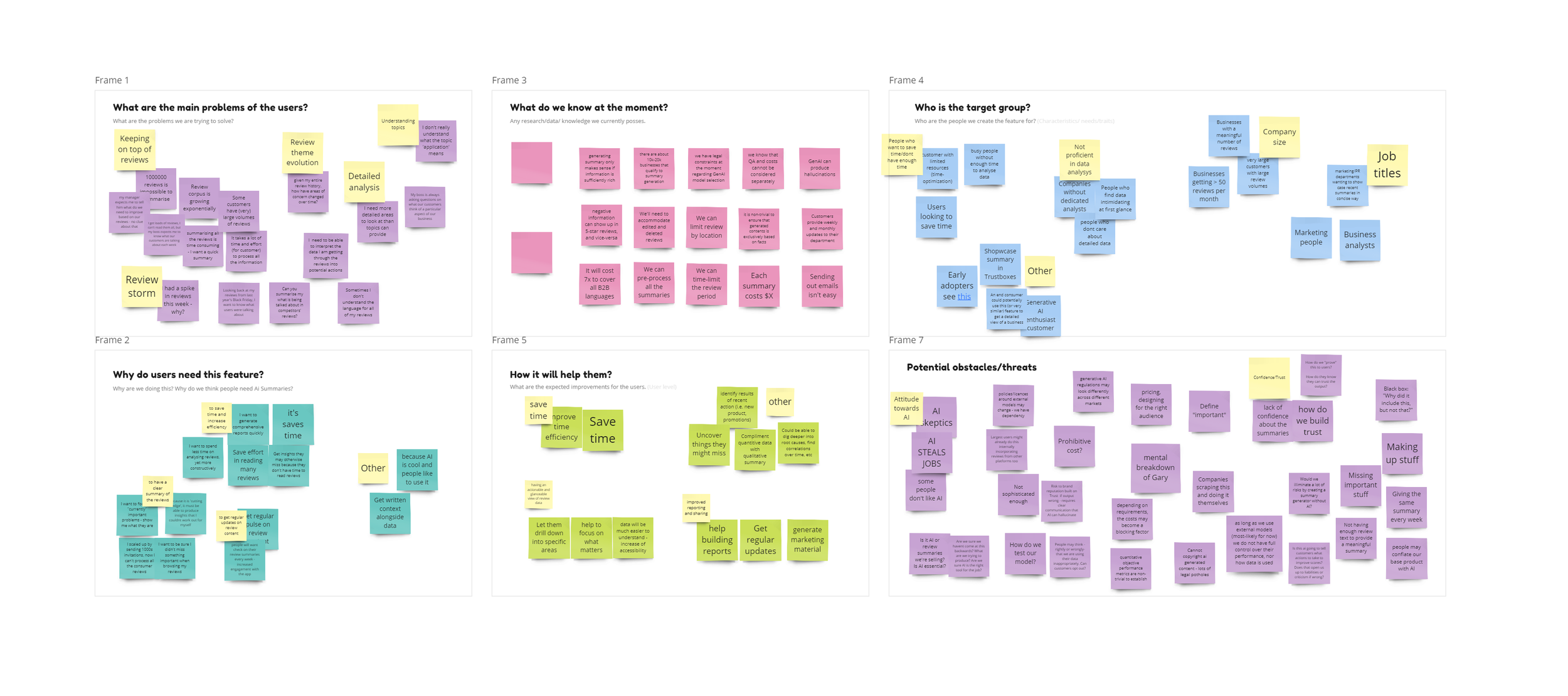
I believe the strongest product decisions are made collaboratively. I facilitated workshops involving Product, Engineering, Data Science, UX Research, UX Writing and a Product Director.
We started with a cross-functional kick-off workshop and continued with regular brainstorms and syncs as the AI model, technical constraints, and solution evolved.
Understanding the problem
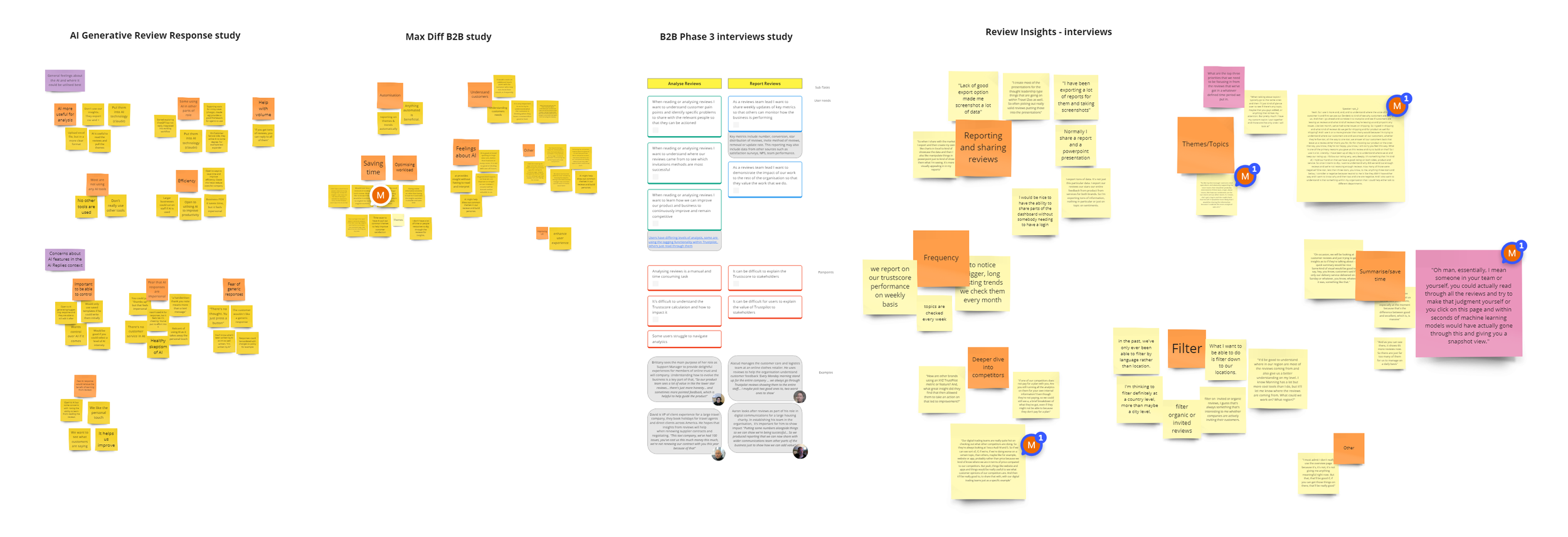
Given the five-week timeline, I started by synthesising four existing studies: two foundational research projects and two other studies conducted for related features.
This allowed us to build on existing knowledge, identify the remaining gaps and focus concept testing on the questions we still needed to answer.
Combined with the stakeholder workshops, the research validated and revealed a clear opportunity to automate review analysis and turn the results into actionable insights.
On the other hand, another observation coming from the user feedback was a strong lack of trust in AI and broader scepticism towards its use. This added another layer of complexity: the solution not only had to provide genuine value, but also earn users’ trust in AI-powered features.
Research insights
Key themes
Increase efficiency through automation
Users valued AI tools that reduced manual analysis and quickly surfaced trends, recurring themes and changes in customer sentiment.
Improve reporting and sharing
Insights needed to be easy to understand, present and share across teams.
Understand customers faster
Users wanted a quick view of positive and negative sentiment without manually interpreting hundreds of reviews.
Receive regular performance updates
Teams needed recurring updates on key themes and review performance to stay informed and aligned.
Support continuous improvement
Users wanted to turn recurring customer concerns into practical product, service and business improvements.
Enable precise filtering
Users needed to filter insights by location and review type, including invited and organic reviews.
User goals
Save time
Quickly understand large volumes of reviews through clear textual and visual summaries.
Turn insights into action
Identify customer pain points and translate review feedback into concrete improvements
Understand customer needs
Recognise recurring positive and negative themes without manually reading every review.
Stay updated and share insights
Monitor changes in customer feedback and communicate important findings to stakeholders.
User needs
Quick AI-Driven Insights
An automated overview of customer feedback and the themes that matter most.
Streamlined Analysis
A faster way to review large volumes of feedback and identify opportunities for improvement.
Digestible summaries and filtering
Concise summaries of key themes, with filters for location and review type.
Easy sharing
Clear, visual outputs that can be shared across teams and stakeholders.
AI Review Summaries is designed for businesses receiving more than 50 reviews per month.
The primary users were product and marketing teams looking for a quick overview of customer feedback, with customer service teams as a secondary audience.
— Target group
Understanding large volumes of customer reviews, identifying patterns and extracting actionable insights requires significant time and analytical effort, making it difficult for businesses to regularly monitor how customer feedback changes over time.
— Problem statement
We believe that turning large volumes of reviews into clear, actionable insights will reduce review-analysis time and lead users to return weekly to monitor changes in customer feedback
— Hypothesis
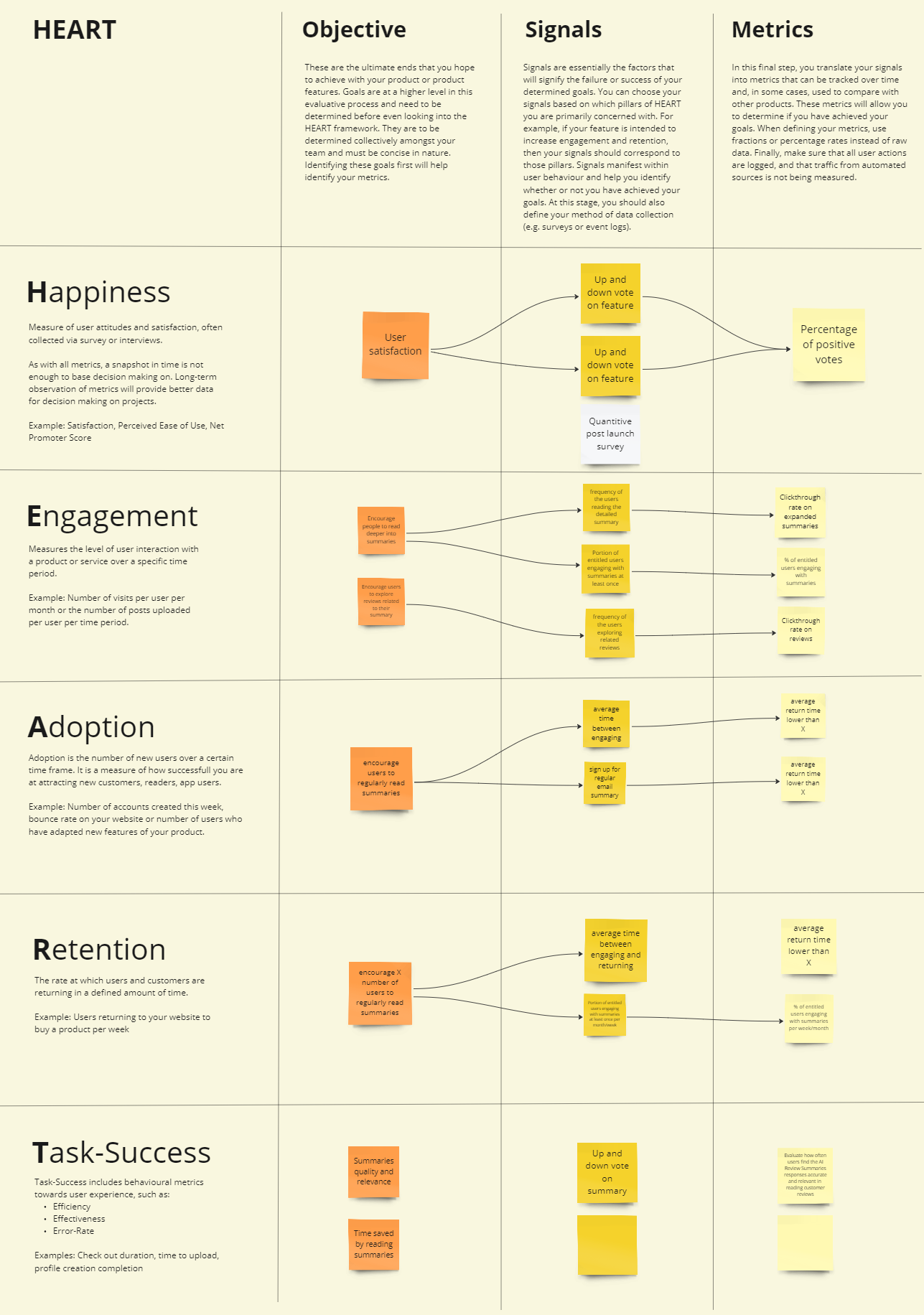
How we defined success
Happiness
80% of users report high satisfaction
Engagement
60% of premium users use the summaries at least four times within the first 30 days
Adoption
80% of eligible free users open the detailed summary
Retention
70% of users return within eight days
Task success
80% reduction in the time required to analyse a week of reviews
The solution
Using the homepage
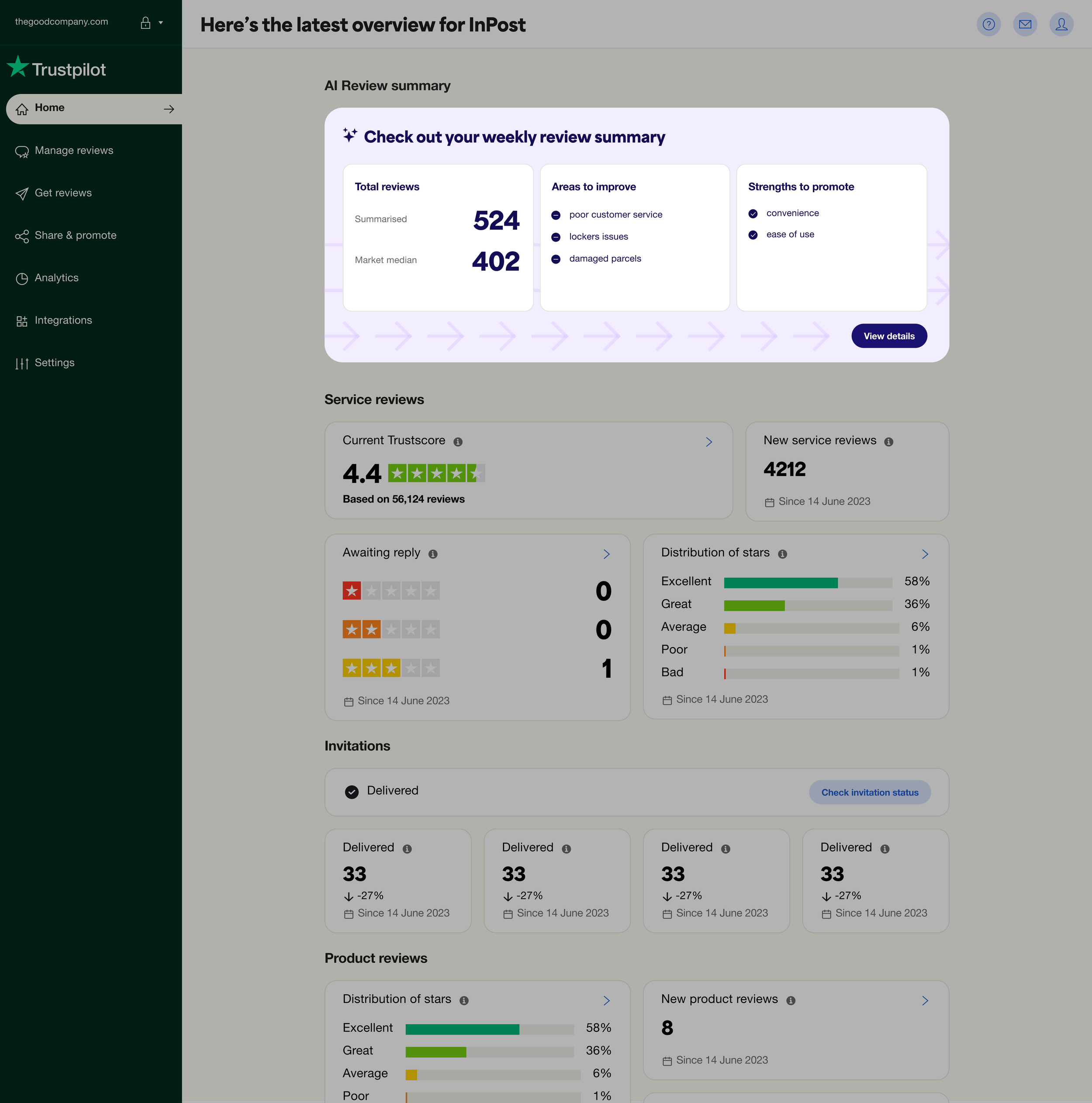
The B2B homepage has the highest traffic but offers little unique value. To make better use of that traffic and revitalise the page, we added an info card previewing the latest weekly review summary.
During usability testing, users strongly indicated that surfacing “areas to improve” and “strengths to promote” sparked their curiosity and made them want to explore the full summary. They also wanted to know how many reviews were included, so we added the total number of summarised reviews to the final design.
The “View details” CTA also gave us a clear way to measure engagement.
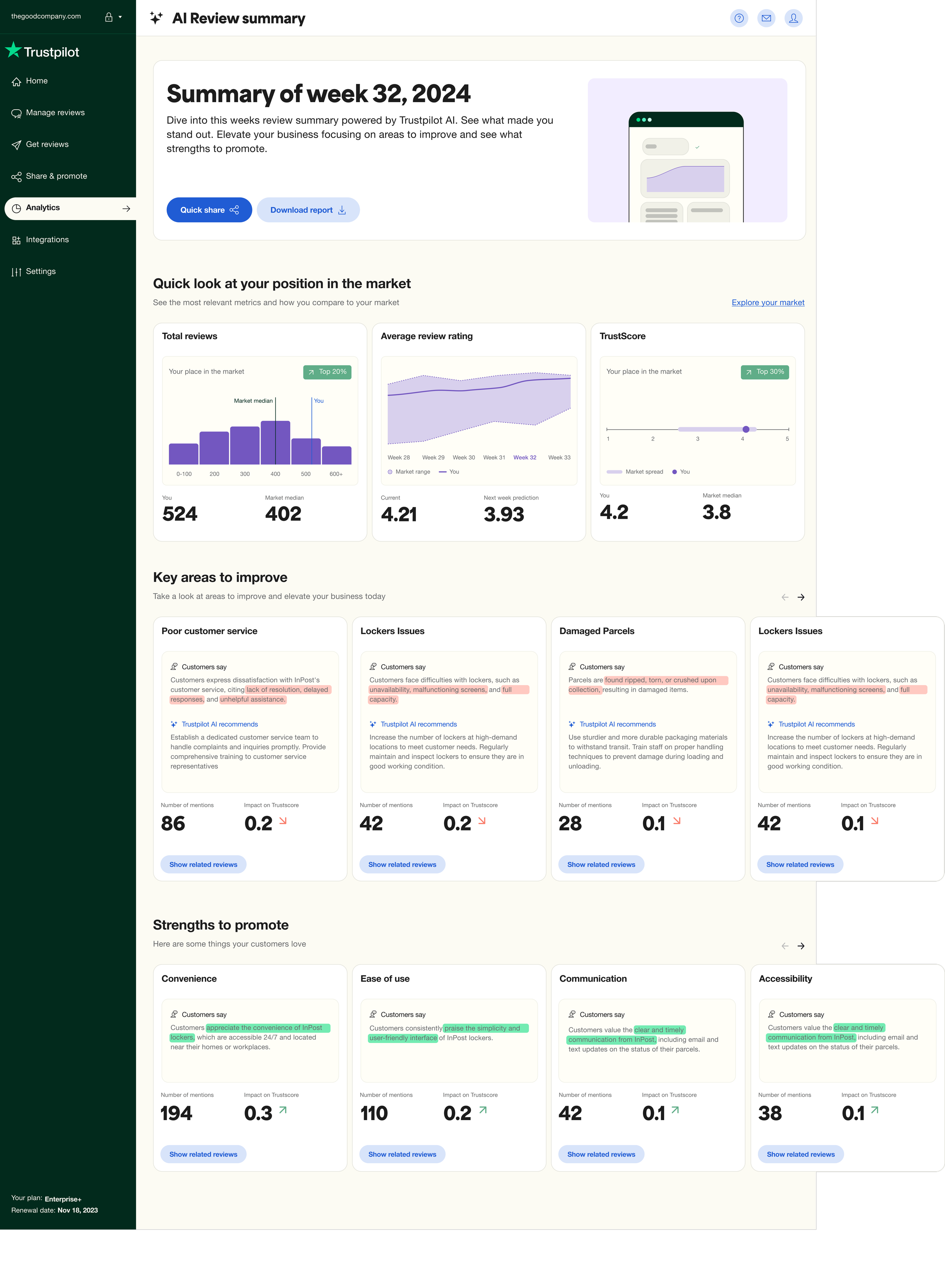
Your weekly AI Review Summary
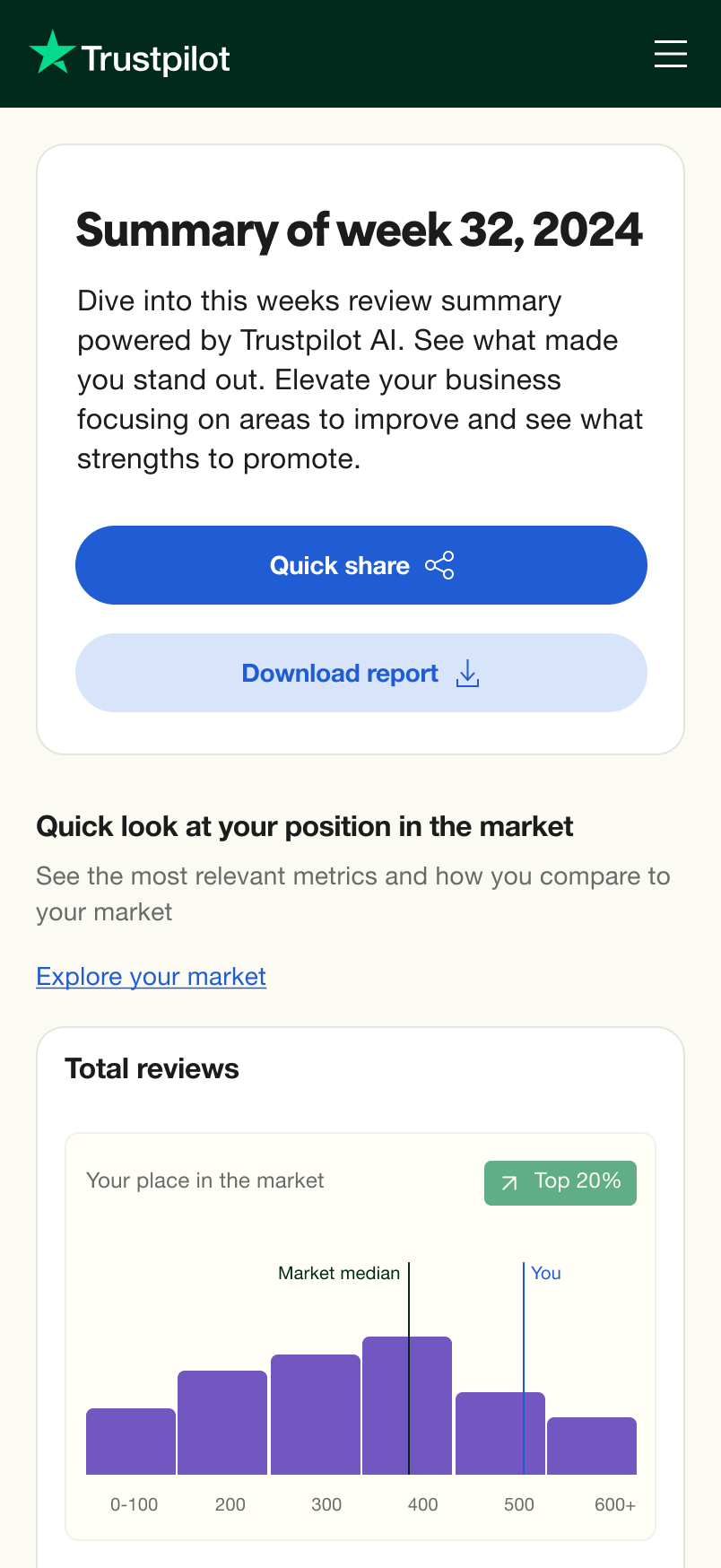
Selecting “View details” takes users to a dedicated AI Review Summary page. It combines market comparisons and review trends with prioritised areas to improve, strengths to promote, AI-generated recommendations and the reviews behind each insight.
We explored several simpler concepts, but a dedicated page allowed us to provide more value and created room for the feature to grow over time.

Exploring the share experience
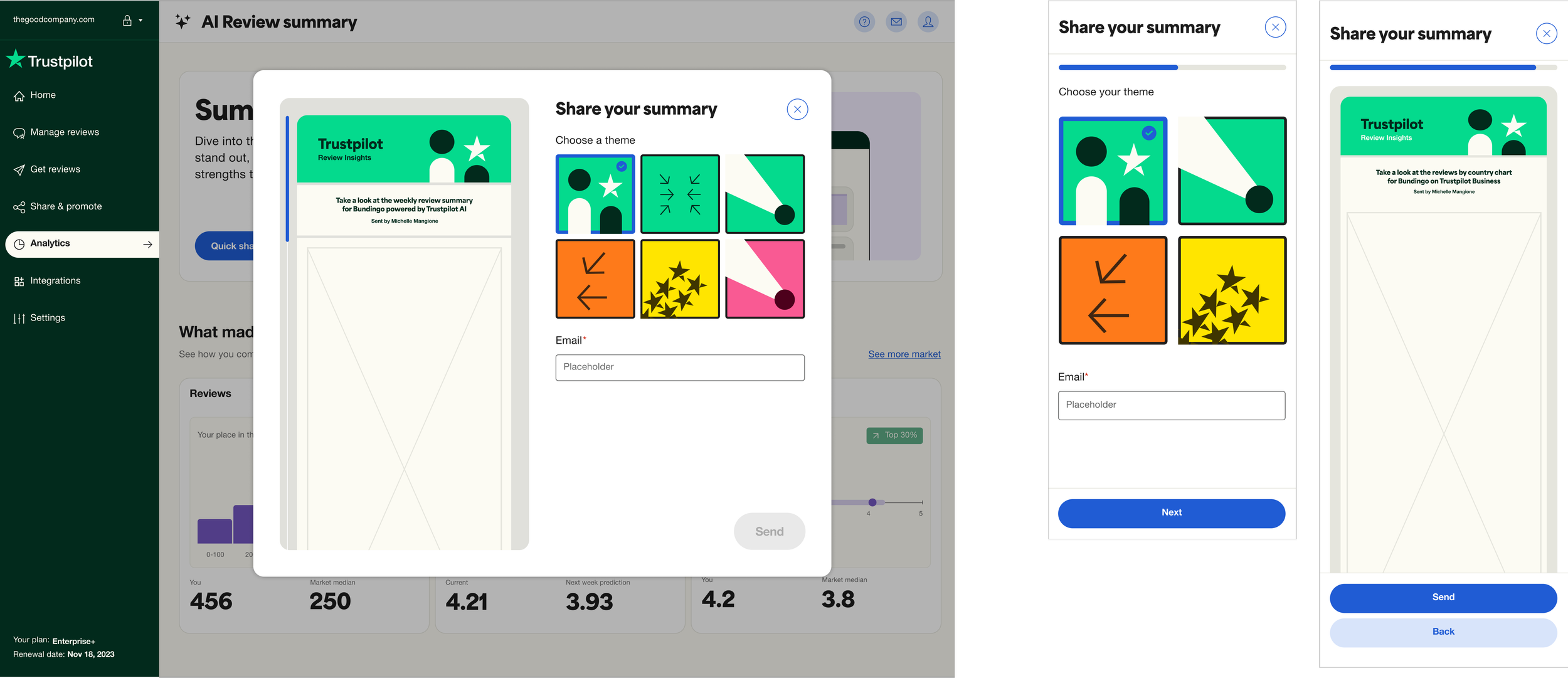
Existing research showed that users wanted an easy way to share review insights with colleagues and stakeholders.
We started by exploring email sharing, building on a feature the team had designed previously. The concept allowed users to choose a visual theme, enter a recipient and preview the email before sending it.
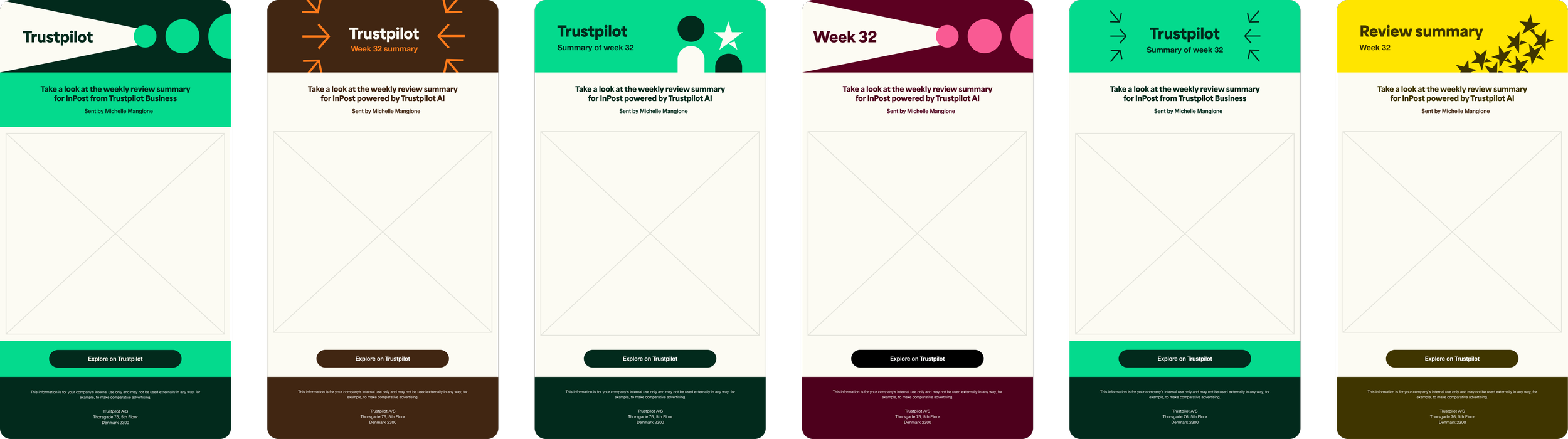
And some template examples
Concepts that didn’t make it*
*initially loved, but proved to be faulty during concept testing
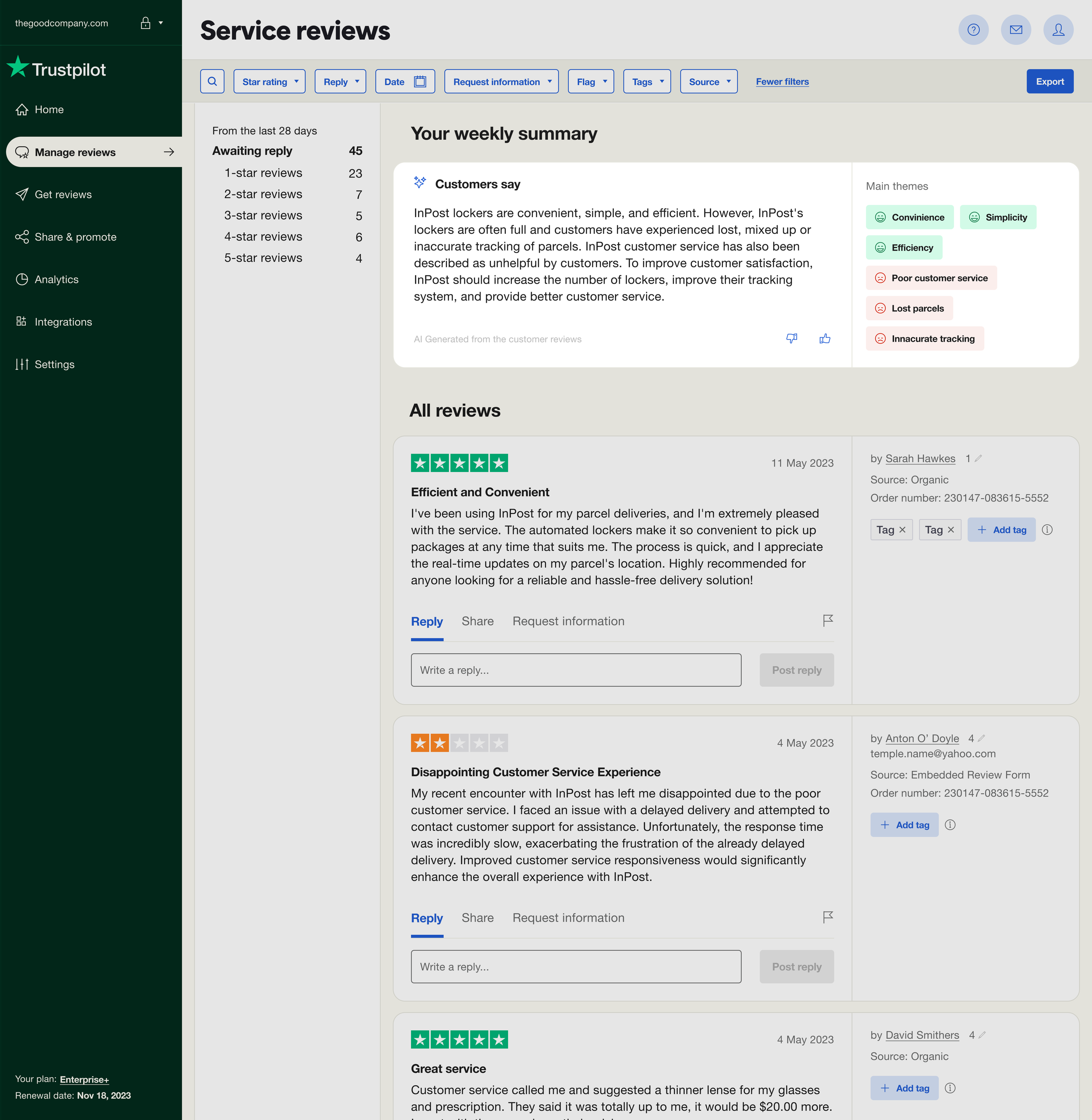
1. Summary in the review inbox
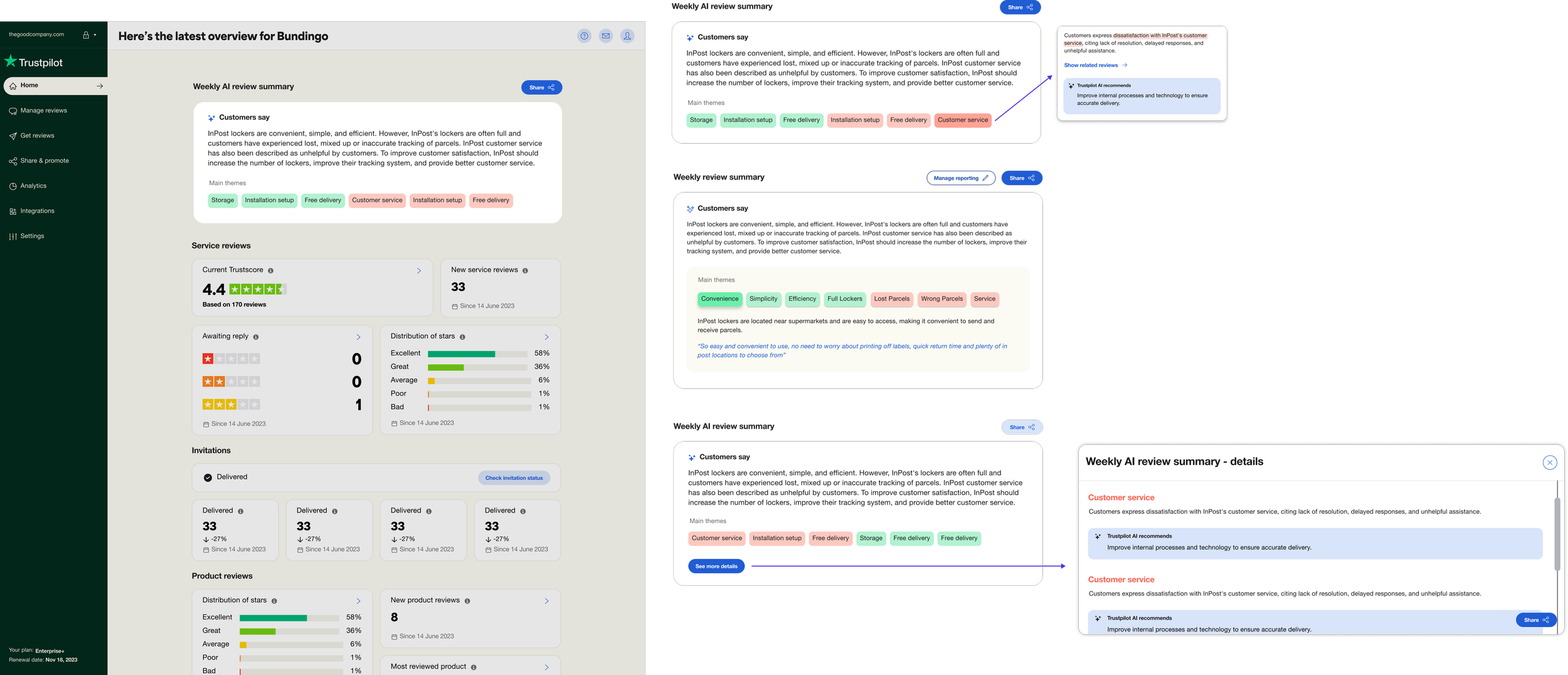
2. “The classic” AI review summary
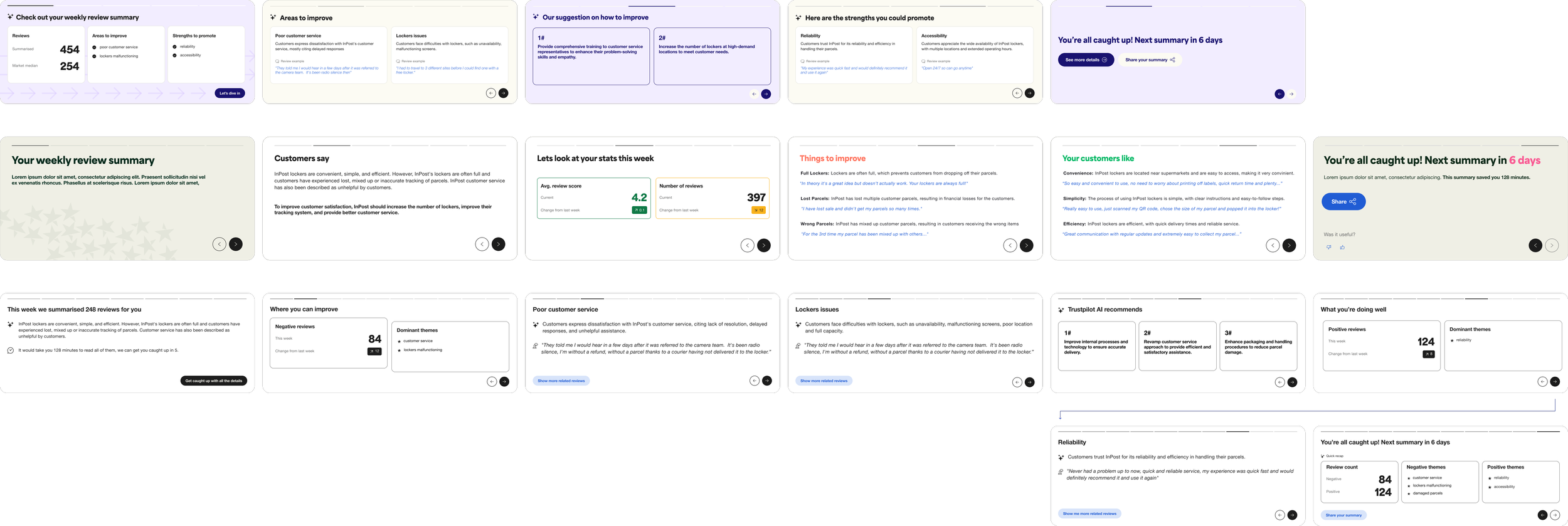
3. Weekly rewind
Problems encountered & lessons learned
The project started with a simple five-week scope: use an AI model to summarise hundreds of reviews into one short block of text. After reviewing the research and workshopping the problem with my product team, it became clear that the initially planned, simple text summary of the reviews would not create enough value.
Users needed something more actionable: data-supported review insights and a way to share the review summary output.
I documented the gaps, presented the case to stakeholders and pushed for a broader solution within the same timeline.
This required close, fast-moving collaboration between Data Science, Engineering, Product and Design. The AI model, UX and technical implementation evolved in parallel, so the design had to stay flexible as new possibilities and constraints emerged.
The project reinforced the importance of scoping carefully, challenging the status quo, prioritising user-focused decisions and staying comfortable changing direction when the product needs it